
Christ Jesus performed such unexpected, extraordinary and abundant works as no one has done before or since. His miracles were numerous, public, full of mercy and compassion, and were all performed by His own power and in His own name.
In this sermon, Ian Forest-Jones reflects on the miracle of the loaves and fishes so that we learn how to both have similar ‘feasts’ and provide such ‘feasts’.
This sermon was delivered on Sunday, 2 August 2026, at South Turramurra Uniting Church. It is based on Matthew 14:13–21. You would do well to read the passage in advance of reading the transcript or watching the video of this sermon.
Transcript
Chocolat

Chocolatis a romance film released in 2000, based on a novel by the English author, Joanne Harris. Chocolat tells the story of Vianne Rocher, played by Juliette Binoche, who arrives in the fictional French village of Lansquenet-sous-Tannes at the beginning of Lent with her six-year-old daughter, Anouk. She opens a small chocolaterie. Soon, she and her chocolate influence the lives of the townspeople of this repressed French community in different and interesting ways.[1]

Armande, played by Judi Dench, is Vianne’s elderly landlady, who is not allowed to see her grandson Luc, as she is a “bad influence”, according to her daughter Caroline. Vianne arranges for him and his grandmother to meet in the chocolaterie, where they bond.

Vianne develops a friendship with Josephine, who is being physically abused by her husband Serge, the local café owner. Through their friendship, Josephine finds the courage to leave Serge after he beats her, moving in with Vianne and Anouk. As she works at the chocolate shop and learns the craft, her confidence slowly increases.

A band of river gypsies camp near the village. Although most of the town objects to their presence, Vianne embraces them. At Vianne’s instigation, they hold a birthday party for Armande with villagers on the gypsy’s boat. When Caroline sees Luc dancing with his grandmother, she begins to accept that Armande’s influence in her son’s life may be positive.
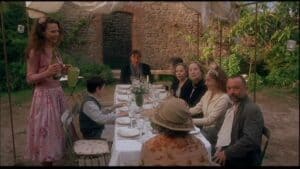
The arrival of Vianne and Anouk into this quaint French village was unexpected, especially since they opened a chocolate shop during Lent, the time of year everyone there was supposed to be fasting. Yet in a short time, Vianne’s generosity was abundant and her grace extraordinary, and this led to transformation in the hearts and minds and lives of some of the villagers.
What & Why?
The example of Vianne and Anouk, a fictional mother and daughter opening a shop and sharing their chocolate, brings to mind the grace and generosity of the Triune God. Similar to these transient chocolate artisans, Christ Jesus performed such unexpected, extraordinary and abundant works as no one has done before or since. His miracles were numerous, public, full of mercy and compassion, and were all performed by His own power and in His own name.
Let us reflect on Jesus’ miracle of multiplying loaves and fishes and, in so doing, learn how we might both havesimilar ‘feasts’ and providesuch ‘feasts’.
Explanation
When Jesus heard [about the beheading of John the Baptist], he withdrew from [Nazareth] in a boat to an isolated place by himself. And when the crowds heard it, they followed him by land from the towns. (Matthew 14:13)[2]
In our scripture focus, we have moved on from Jesus’ parables in The Gospel of Matthew, chapter 13.
The setting of Matthew 14 begins with the puppet-king of the Jews, Herod the tetrarch, arresting and then executing John the Baptist. When Jesus heard about the death of his cousin, he “withdrew from [Nazareth] in a boat to an isolated place by himself” (Mt 14:13). Why did he do this? More than likely because he wanted and needed to grieve.
As he got out [of the boat], he saw the large crowd and had compassion on them and healed their sick. (Matthew 14:14)
I am certain the news of John the Baptist’s execution would have circulated. They did not have social media back then, but news always travels fast and John the Baptist was a religious celebrity. The crowd did not care that Jesus needed some time to be alone. All they cared about was their own condition, their own needs —does this sound familiar? Nevertheless, seeing them, Jesus put aside his own grief because He had compassion for the crowd. Jesus put aside His own need for compassion so that He might heal the sick among them.
It is because of stories like this no one will deny Jesus was a great man. How much we yearn for leaders and examples such as He in our day and age. Who among us will step up to lead the way in following Jesus example?
When it was evening, the disciples came to [Jesus] saying, “The place is desolate and the hour is late. Release the crowds so that they can go away into the villages and purchase food for themselves.” (Matthew 14:15)
With that background in mind, notice the timing of the miracle. The evening had come, it was late, meaning, literally, the time for the evening meal had passed. Jesus had been healing and teaching the people. The crowd had been so deeply interested in what He was doing among them, they forgot the needs of their own bodies. Everyone was likely starting to take notice of their hunger.
Notice also the location of the miracle. It was a desolate place. Had they been near a city or village, the crowd could have easily obtained food for themselves, a miracle would have been unnecessary.
Christ Jesus never performed superfluous miracles. The need of the moment made it necessary that He should demonstrate He could provide for the people in the wilderness.
Does this remind you of God providing manna, quail, and water for the ancient Israelites in the wilderness? Does it remind you of the great feast God is preparing for His people on the day of the Lord? It should.
Noticing the timing and the place of this miracle, we should not be surprised at the anxiety demonstrated by the disciples. They naturally wanted to dismiss the people so they could go and find themselves some food in the villages. They reasonably surmised dismissing the crowd to be considerate and humane. They too wanted to procure some food for themselves, for they were also hungry.
We should never forget we all have bodies as well as souls. If we see a brother or a sister, or even a neighbour, in hunger and we feel no compassion for them, how can we say the love of God is in us? (Jam 2:14-17)
Jesus said to them, “They do not need to go away. You give them something to eat.” And they said to him, “We do not have anything here except five loaves and two fish.” (Matthew 14:16–17)
Now, notice the surprising reply of Jesus: “They do not need to go away”.
By that time, the crowd was obviously hungry, and reasonably so, but “man must not live on bread alone” (Lk 4:4). Not only was the promised Messiah of God in their midst, but that Messiah was the God of nature and providence. As the Messiah, Jesus’ heart was full of compassion and so His hands were open for and willing to supply every living thing with every good thing.[3] With that attitude and heart-orientation, Jesus directed the disciples to provide from whatever they possessed.
Did He really think the disciples would have enough on hand to feed this crowd? Most certainly not. Nor was it likely there was enough on hand amongst the crowd to feed everyone, for no one had prepared for this eventuality. In fact, only five loaves and two fish were all that could be found. How totally inadequate this was to meet the demands of that hungry multitude. A miracle would truely be necessary.
[Jesus] said, “Bring them here to me.” And he commanded the crowds to recline for a meal on the grass. (Matthew 14:18–19a)
Jesus then commanded His disciples to bring the bread and fish to Him. He did not scorn nor dismiss the meagreness of what was available, but made these elements the catalyst —or the seed, as it were— of the abundance which He was about to provide. The hands of the disciples could do little with the loaves and fish at that point; therefore, Jesus received them so that His almighty power might be employed upon them.
Next, Jesus commanded the crowd to sit down that all might be done in order, that the number of people might be accurately ascertained, and that all might be easily and fully supplied with the provision.
Taking the five loaves and the two fish and looking up to heaven, [Jesus] gave thanks. And after breaking them, he gave the loaves to the disciples, and the disciples gave them to the crowds. And they all ate and were satisfied, and they picked up what was left over of the broken pieces, twelve baskets full. (Matthew 14:19b–20)
Now notice Jesus’ conduct with respect to the bread and fish. He took them, lifted up His eyes to Heaven, gave thanks, blessed the elements, and broke the bread. What an example of piety and devotion! How anxious He was to acknowledge and glorify His Father! What majesty and glory would have be seen in the face and actions of Jesus on this occasion!
Jesus could have been flippant with His authority, as He was tempted to do so in the wilderness by Satan (Mt 4:1ff). He could have been ostentatious with His power, but He chose instead to set an example of humility and love.
That was Jesus’ attitude, but notice also His action in how He had the elements distributed: He gave the food to His disciples, who then gave it to the people. In this, Jesus exhibited His leadership and authority, yet in His action recommended His disciples to the people, for He delegated to them the responsibility to distribute the elements, as leaders within the Kingdom.
Pay attention now to the creation and multiplication of the food which took place. Jesus prayed over the meagre and insufficient food, then passed portions to the disciples. The disciples then moved among the crowd and passed out from the portion they possessed. Where along this process the food multiplied is not to be known. Our concern is only that this little food became a lot. A single person’s meal became an abundance, such that 5,000 men, besides likely as many more women and children, everyone ate and was satisfied.
While our scripture focus does not say so explicitly, we can imagine Jesus then said, “Gather up the left over, that nothing be lost.” And twelve baskets of fragments remained! He did not do this to prove that many times more than the initial loaves and fish were produced! God is the source of abundance, but He will not sanction extravagance or waste.
In this story, the generosity and grace of Christ Jesus our Lord was demonstrated. He set an example for the disciples and for us. How then might we put the lessons of this miracle into action in our community and in our lives?
Application
I am going to assume that you have been reflecting on the parables of Matthew 13 these past couple of weeks since they were assigned by the Lectionary. Those parables may have left you feeling, “How can my life and faith be unexpected, extraordinary and abundant?”
This story of the feeding of 5000 itself certainly qualifies as unexpected, extraordinary and abundant, yet it also demonstrates how your ordinary life and simple faith can become unexpected, extraordinary and abundant, exactly as God intended.
A Community of Abundance
In the people of this story we see a striking representation of the moral condition of the human family, then as now. We live in a desert world —starving for life, light and love— having no human means of supply, so we are drawn to any glimpse or promise of satisfaction.
In the provision of loaves and fish in this story we see a true example of the blessings of the good news about the Kingdom. The source of these blessings is Jesus. He prepared a feast for His disciples and the crowd! At first, the elements appeared insufficient, yet their abundance was inexhaustible. This meal was free and cheap, we might say; it required no money, for it had no price. Then, as now, the feast the Lord prepares is satisfying for those who taste and see, for they are filled.
In the distribution of this feast we see the community of the friends of Jesus at their best. Then, as now, we come to Jesus with what little we have. He takes it and blesses it, with humility and love, and hands it back to be dispersed to a dying world. We offer; Christ provides; we then distribute the unexpected and extraordinary abundance.
We are not a room of spectators, but an ordered and intentional community of participants. We offer what little we have when we can. We are helpers and leaders in a variety of ministries[4] all of which, in their own way, contribute to our discipling one another around the table of the Lord.
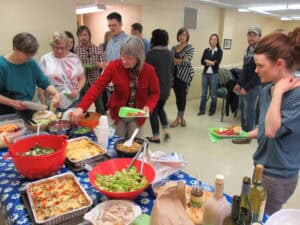
Let us consider the example of the morning fellowship team. Gathering for worship is an important part of the Christian experience, but it is in fellowship after the service that we begin to live as one. We share a cuppa and stories and wisdom. We celebrate and commiserate with one another if are open enough to each other to be real and honest with each other. In the sharing of food and conversation, we listen for ways we can bless each other and serve one another.
It is imperative we have enough volunteers to put on the kettle and clean up the table. How will we and our guests know and experience the feast of faith without someone preparing the table for us?
You may think you do not have anything to offer, that you could not be of any service to this community. Remember what Jesus did with five loaves and two fish, a meagre and insufficient meal that fed thousands miraculously. We each need to know we are loved and cared for, that we have a contribution to make and we they can make a difference. We need a safe haven from the desert-world. We need to worship, to love and to serve. This does not happen accidentally. This community of faith can rally around each other AND those who come within our sphere of influence. We can show each other and guests the unexpected, the extraordinary and the abundant, thus giving us all a grander vision of light and life and love, from God’s perspective.
Together we enjoy the feast the Lord prepares and provides, and our lives are richer for it. They are free, full and forever.
A Sanctuary of Abundance
Each of us have a part to play in one another’s life and faith. We can only give what we have ourselves received. And remember our Creator always intended this feast to be shared.
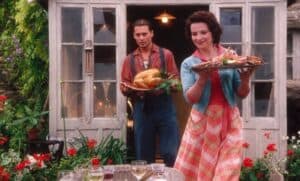
In the movie Chocolat, the character Vianne was compelled by the wind to take her daughter and set up her shop in a new location. She did not prepare and sell chocolates with the express purpose of changing lives, yet that is precisely what happened as she shared the fruit, or should I say truffle, of her labour. The chocolate shop became the venue for feasting, where villagers and gypsies could be brought to peace with one another and joy was shared.
Each of us can take the truffle of the Spirit we have received —the love, joy, peace, patience, kindness, goodness, faithfulness, gentleness, and self control (Gal 5:22-23a)— and share that truffle of the Spirit in our homes, our schools, our clubs, our teams, our workplaces, our third places. The world will try and convince you those are not the characteristics that succeed, but the lust of the flesh and of the eyes, and the pride in one’s possessions (1 Jn 2:16) do not build up. They destroy!
Understanding that people tend to belong in order to believe and believe in order to understand, let me encourage and equip you in a lifestyle hack that will help you to B.L.E.S.S. your neighbours:
- Begin with prayer
- Listen
- Eat
- Serve
- Share our own and God’s story
The acronym B.L.E.S.S. will help you to ‘share your truffles!’ Invite others to feast with you, strangers and friends alike. In providing such moments of feasting, you just may participate in a miracle. Your offering to a sick and dying and deserted world bereft of light, life, and love will be received by the Lord and miraculously transformed into something unexpected, extraordinary and abundant, feeding others physically, mentally, emotionally, socially and spiritually.
But here is the key to the Christian lifestyle: you are able to share your truffles with your family, friends, neighbours, and associates bereft of light, life, and love because you have done so with your community of faith! Your morning tea fellowship is practice for B.L.E.S.S.ing those in your sphere of influence —those in your household, in your neighbourhood, on your sports team, in your school, those you meet in your favourite café or binsu bar. Bless each other here so you can bless others out there!
Conclusion
This story of Christ Jesus feeding 5000 was an unexpected, extraordinary and abundant work. All of His miracles were numerous, public, full of mercy and compassion, and were all performed by His own power and in His own name.
Let us follow his example by relying on His power so that we too may perform miracles in His name, in our time and place.
Endnotes
[1]Adapted from a sermon outline provided by Jabez Burns, “The Miracles of the Loaves and Fishes”, Sermon Outlines on the Life of Christ, ed. Al Bryant (Grand Rapids, MI, USA: Kregel Publications, 1993), pg 56.
[2]Unless otherwise noted, all scripture quotations are taken from The Lexham English Bible (Bellingham, WA, USA: Lexham Press, 2012).
[3]See 1Kg 3:13; Mt 6:33; 19:28; Mk 10:29; Lk 18:29; 1Tm 4:8; Jam 1:17.
[4]Insert here local examples —e.g., children’s ministry, administration, hospitality, prayer, small groups, fellowship and outreach, music, production, worship presiding, welcoming, pastoral care, teaching, etc.

Leave a Reply