
“If you don’t know where you’re going, any road will get you there.” For men, we need to know where we are going and we need other men to help us get there. That is God’s design and Jesus is an exceptional man who we can trust and whose example we should follow.
This sermon is based on Matthew 21:1–17[1] and was delivered on Sunday, 6 September 2026 at South Turramurra Uniting Church (it was Father’s Day in Australa). You would do well to read the passage before watching the video or reading the transcript below.
Transcript
On a Road to Nowhere

In the classic children’s fantasy by Lewis Carroll we find this exchange between Alice and the Cat:
“Would you tell me, please, which way I ought to go from here?”
“That depends a good deal on where you want to get to”, said the Cat.
“I don’t much care where–” said Alice.
“Then it doesn’t matter which way you go”, said the Cat.
“–so long as I get SOMEWHERE”, Alice added as an explanation.
“Oh, you’re sure to do that”, said the Cat, “if you only walk long enough.”
Although not a direct quotation, a fairly good summary and paraphrase of this exchange is the oft shared,
If you don’t know where you’re going, any road will get you there. (author Lewis Carroll, paraphrased)
I too enjoy an adventure found by just choosing a road and seeing where it will take me, whether while running or on my motorcycle.
Despite these momentary and fanciful pleasures, the human condition shared by all of us at present includes a fear that we are on a road to nowhere because we all know we should be going somewhere. It is absolutely true we all need a map or, in the case of Father’s Day, boys and men need other men, and wiser men, to show them the way to live prosocial, virtuous lives.
Keep Your Head Down
Therefore, while it is true we are in a difficult time for all of us, it is an uniquely and unexpectedly difficult time for men. According to the International Council for Men and Boys, “Across Australia, men and boys face stark gender gaps in education, health, family life, safety, and employment, with national statistics showing significantly poorer outcomes in several key areas.”[2]
Because I said that, if you are thinking to yourself, “Yeah, but what about the women?”, then you are both missing the point and proving my point.
As a further illustration, I once posted on my social media channels an image with the following quote,
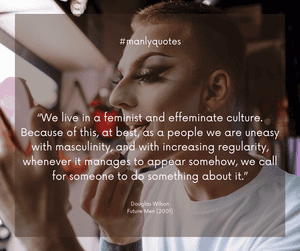
We live in a feminist and effeminate culture. Because of this, at best, as a people we are uneasy with masculinity, and with increasing regularity, whenever it manages to appear somehow, we call for someone to do something about it. (pastor and author Douglas Wilson)
Of course, some of my online ‘friends’ reacted to the opening sentence. What they failed to notice is the opening sentence is actually the conclusion of the author’s argument. The argument of the provocative pastor and author Douglas Wilson would be better understood if he had written,
- “as a people we are uneasy with masculinity” (premise 1);
- “whenever it manages to appear somehow, we call for someone to do something about it” (premise 2);
- therefore, “We live in a feminist and effeminate culture” (conclusion).
Laying out Wilson’s argument this way, you might still disagree with his conclusion, which is not a statement of fact but a biased observation. To challenge his observation though you need to address his premises by providing better examples against than his examples for. The more compelling the examples you have that demonstrate his premises are weak these will then undercut his conclusion.
Sadly, none of my ‘friends’ provided examples against. What they did do was challenge the author’s right and freedom to voice his opinion at all. One friend first insulted the author, then implied he had no right to make any such observation because he is a male. My friend then challenged my examples for the conclusion as being insensitive and flawed. He then made his own observation, “we are a male dominated culture and we are the poorer for it” —which is itself a biased observation.
Why is it acceptable for my friend, a male, to criticise masculinity (which is a biological imperative) but it is not acceptable for a man to criticise feminism (which is an ideology)? My friend stated I was devaluing women’s life experiences when I was merely highlighting to men that our life experiences are equally worthy of attention. In the end, posting this quote in defence of masculinity proved the author’s point: To speak up for men and their needs is to risk ridicule and cancellation.
Thus my contention it is an uniquely and unexpectedly difficult time for men.
What & Why?
On this Father’s Day, I do not want to dismiss or devalue women and girls in any way. Yet, it is a biological fact males and females are different. As Australian cultural commentator and pastor Mark Sayers put it,
The world is complex and humans are sinful, so we need to be careful going forward that in our reaction against the injustices of the past, we don’t create new ones in the future. (Australian cultural commentator and pastor Mark Sayers)[3]
For men, we need to know where we are going AND we need other men to help us get there. That is God’s design and Jesus is an exceptional man who we can trust and whose example we should follow.
Before I continue, let us pray:
Awaken our hearts and minds
to your Word, O God.
Give us understanding so that,
by the power of your Holy Spirit,
we are able to do all that you command
for love’s sake.
Gathered in Christ’s name,
gathered around the Word,
we pray. Amen.[4]
Explanation
Define The Terms
In order to make the case for men, I need to first acknowledge that, when discussing this issue, the terms used really are confusing.
Sex: Biological sex is usually determined by one of two features. First, a genetic profile, being either XX chromosomes for female or XY for male. One’s genetic profile typically results in the production of either ova or spermatozoa and the second feature of sex is the development in utero of male or female primary sexual characteristics (penis and testes or vagina and uterus, respectively).
There are only two biological sexes. Intersex is a term indicating the condition of a person who has some disorder in their chromosomes, gonads (ovaries or testes), hormones, or external/internal genitalia, but the underlying genetic profile can only be female or male.
Gender or Gender Identity: These are the terms that causes the most confusion. They refer to one’s internal sense of being male or female. For most individuals, biological sex and gender identity correspond. However, for a very small number of individuals, they may not, which produces a distressing condition known as gender dysphoria.
Of course, it is fair to ask how a person can believe their subjective gender is other than their sex when he or she can only ever engage the world through their objective biology?
Gender Role: This term generally refers to societal expectations of how individuals are likely to behave based on their biological sex.
Masculinity: This term refers to the compliment of traits we normally associate with the male sex —the same can be said for females and femininity. According to Dr. Scott Barry Kaufman:
Consistent with prior research, researchers found that the following [personality] traits are most exaggerated among females […]: sensitivity, tender-mindedness, warmth, anxiety, appreciation of beauty, and openness to change. For males, the most exaggerated traits were emotional stability, assertiveness/dominance, dutifulness, conservatism, and conformity to social hierarchy and traditional structure.[5]
Therefore, research confirms that, based on our biological differences, males and females tend to have different personalities, among other demonstrable differences.
However —and this will surprise you— masculinity is not sex specific. Both males and females can exhibit some level of the traits expected of the opposite sex. This is why we have effeminate men and masculine women. Despite our biology, we may exhibit some traits expected of the opposite sex, or a combination thereof, to a greater or lesser degree than expected.
It should be noted though that culturally both masculine women and feminine men tend to be avoided outside of their subcultures.
Therefore, given all the current confusion, both masculinity and femininity are really not useful terms at all. For males, I believe it is more helpful to speak of manliness and manhood. These terms refer to the traits and roles traditionally ascribed to males exclusively. In other words, what we expect of males based on their biology.
Manhood Is Not Natural
Now, having a better grasp on the relevant terms and their usefulness, let me know turn to the issue of how manhood and manliness develop in males. According to Glenn T. Stanton, Director of Global Family Formation Studies at Focus on the Family,
Manhood is not natural, but it is essential. No society can endure if it does not harness male sexual energy and teach men to take care of the children they father and the women who bear them. (Glenn T. Stanton)[6]
How does Stanton come to this conclusion?
If we were to be honest, we would have to admit girls become women more naturally and more easily than boys become men. Stanton notes,
A female’s biological make-up usually ensures that she will grow into a healthy woman. Leave her to herself, and it’s likely to happen. It’s why the phrases “woman up,” “be a woman,” or “make a woman out of her” don’t exist.
As her body matures, internally and externally, it sends her and those around her an unmistakable message about what she is and what she’s becoming. It moves her inexorably in that direction with a force as great as it is mysterious. Few girls miss these cues. It’s not just her body that is changing; she is becoming a different person. Her family and community treat her differently because of it. A father shudders at it, as it forever changes the way he interacts with “his little girl.” He must bow to and honour it…
Women must be taught, with great political and ideological pressure, to ignore their womanhood and abandon their children, for doing so is contrary to all nature. (Glenn T. Stanton)
Boys, on the other hand, need to be taught how to be men and especially how to be good men. According to Stanton,
Maleness just happens, but manhood does not. The first is a biological event, while the second is a developed character quality. When manhood is not formed and cultivated, males fail to mature, resulting in the “perpetual adolescence” or “failure to launch” that plagues our culture. When so many men play beer pong into their forties, live in their parents’ basements, play video games twelve hours a day, and encounter women only in the form of pixels on a porn site, it seems clear that we have a manhood problem. (Glenn T. Stanton)
We have a manhood problem because boys need to be guided by older males toward virtuous manliness and equipped to assume the roles and responsibilities of manhood associated with males —namely, to protect, procreate, and provide.[7]
Interestingly, as boys transition into adult males, they need a “band of brothers” to affirm their manliness. This means that to maintain a boy’s place in his group involves demonstrating the tactical virtues of strength, courage, mastery, and honour.[8] Demonstrating these basic, tactical virtues makes a male good at being a man.
Males will always and naturally form a band of brothers, but without the formation provided by older males, those brothers will only perpetuate immaturity, what is now derisively called toxic masculinity but is more properly called hypermasculinity.[9]
Examples, Good and Bad, of Manhood
To help you get ‘your head around’ this process, consider some examples of those good at being men but who are not good men: they include Anakin Skywalker (who was manipulated into supporting the evil empire by killing the innocent younglings), Negan (a villain in The Walking Dead television series who was the totalitarian, sociopathic leader of the Saviors from season 6), and Michael Jordan (an elite athlete whose extreme competitiveness led him to not being a “nice guy” to his own teammates).
Examples of those we might consider good men but not good at being men include transgender women (you might applaud their cause but they remain biological males), Robin Williams (a celebrated actor and comedian who committed suicide), Mark Latham (you might applaud his policies and capacity as a politician, but his domineering stance toward John Howard during a handshake may have cost him the election), and our current Prime Minister Anthony Albanese who very inappropriately revealed his feelings about singer and actress Kylie Minogue on a public podcast episode recently.[10]
Example of those good at being men and good men include Rudyard Kipling (though study of his life and writings have fallen out of fashion, he was a manly man who knew what genuine manhood was and defined it for his generation in his writings, even though he was small, unathletic, wore glasses, was bookish, bullied and insecure, yet he did not let his shortcomings get in his way), Winston Churchill (being Prime Minister during WWII is only one of his many accomplishments; his life was rich and productive; his gifts were measured in the gratitude of millions), and Dan Price (as CEO of the company Gravity Payments, he lives simply and raised the minimum salary of his employees to “the optimum salary for happiness”).
All of these examples are debatable because, as I have already noted, manhood is affirmed by other men. So you might agree or disagree with these observations about these men. However, if you want to find an exceptional man, about whom no one can truly disagree, then look no further than Jesus the Christ.
Jesus was ‘a man’s man’. He excelled as a protector (e.g., he defeated sin and death; warned against false and hypocritical teachers and leaders; and, he exorcised demons from those possessed and he calmed storms threatening his disciples); he excelled as a provider (e.g., his miraculous catch of fish; feeding thousands of people, twice; his offer of “abundant life” is a better offer than the “thief” who comes only to kill and destroy); and, Jesus excelled as a procreator (e.g., inviting and enabling others to become children of God).
Look no further than our scripture focus, Matthew 21:1-17, to see Jesus fulfilling his role and responsibilities as a man. It is written,
And the crowds who went ahead of him and the ones who followed were shouting, saying,
“Hosanna to the Son of David!
Blessed is the one who comes in the name of the Lord!
Hosanna in the highest heaven!”But when the chief priests and the scribes saw the wonderful things that he did, and the children shouting in the temple courts and saying, “Hosanna to the Son of David!” they were indignant. (Matthew 21:9, 15)
When you read that passage, note how everyone, from children to leaders in the community, responded to him.
Being an exceptional man does not mean Jesus isn’t also an example for women. All of us should consider how to follow Jesus’ example in placing our faith in God and living a Christian lifestyle. When we do so, the triune God guides us to maturity, as it is written,
And so, dear brothers and sisters, I plead with you to give your bodies to God because of all he has done for you. Let them be a living and holy sacrifice—the kind he will find acceptable. This is truly the way to worship him. Don’t copy the behavior and customs of this world, but let God transform you into a new person by changing the way you think. Then you will learn to know God’s will for you, which is good and pleasing and perfect. (Romans 12:1–2, NLT)[11]
Application
Pursuing Virtue
So how does a male become good at being a man and also a good man? Placing his faith in Jesus and seeking to live a Christian lifestyle, with the guidance of elders and affirmed by peers, a male becomes good at being a man by utilising his manliness and manhood for a cause greater than himself.
There are many ways to describe this process of fulfilling the roles and responsibilities of manhood and pursing the virtues of manliness, but the American author Stephen Mansfield described it very succinctly in his book Mansfield’s Book of Manly Men.[12] Based on his experience and research, Mansfield described four principles, what he calls maxims:
- manly men do manly things;
- manly men tend their fields;
- manly men build manly men; and,
- manly men live to the glory of GOD.
The first maxim encourages males to start by pursuing the virtues of courage, strength, mastery and honour. The second refers to the roles a man fills in his immediate environment: protect those around you, build a family, provide for your family and brotherhood through gainful employment, etc. The third maxim covers both affirming healthy manhood and manliness in your band of brothers AND guide those below you as a mentor or elder.
The final of Mansfield’s maxims describes the value and ethic of faith in Jesus and a Christian lifestyle. Using your manhood for a cause greater than yourself puts you firmly on the path to becoming good at being a man. What cause is greater than that outlined by our Creator? In The Book of Genesis is described the cultural mandate for men and women:
And God said, “Let us make humankind in our image and according to our likeness, and let them rule over the fish of the sea, and over the birds of heaven, and over the cattle, and over all the earth, and over every moving thing that moves upon the earth.” So God created humankind in his image, in the likeness of God he created him, male and female he created them. And God blessed them, and God said to them, “Be fruitful and multiply, and fill the earth and subdue it, and rule over the fish of the sea and the birds of heaven, and over every animal that moves upon the earth.” (Genesis 1:26–28, emphasis added)
Your purpose as a man (and as a woman) is to represent God as His image in protecting, procreating and providing within your spheres of influence and to your capacity. When you mature into a good man you are fulfilling God’s purpose in creating you.
Committing our manly selves to the eternal purpose of God restores us to our Creator’s design and gives us a purpose to live for.
Mentor Men
Here’s the final application: no male is going to fulfill these maxims unless someone teaches them to him, and encourages and equips him along the way. If you are a male who has placed his faith in Jesus and are seeking to live a Christian lifestyle, then encourage your peers when they make prosocial choices and demonstrate virtuous living. And, especially, equip those younger than yourself as a father, mentor or an elder, in how to make prosocial choices and demonstrate virtuous living.
This is what it means to be both good at being a man and a good man; yet, how will males know this is their purpose unless someone cares enough to teach them? Churches should be safe spaces for males to learn how to fulfil the roles of manhood and attain the virtues of manliness.
Conclusion
Yes, it is true, if you don’t know where you’re going, any road will get you there. No one is comfortable wandering aimlessly. For men, especially, we need to know where we are going AND we need other men to help us get there. Be a manly man, that is God’s design for you. Place your faith in Jesus for He was an exceptional man. Follow His example for your own Christian lifestyle and live to the glory of God. Encourage and equip the same in others, for that is a cause worth using your manhood and manliness for!
Endnotes
[1]Unless otherwise noted, all scripture quotations are taken from The Lexham English Bible (Bellingham, WA, USA: Lexham Press, 2012).
[2]International Council for Men and Boys, “Australia Confronts a Widening Divide Affecting Its Men and Boys” [press release], Menandboys.net, 21-Aug-2026, https://replug.link/79891795 (accessed 3-Sep-2026).
[3]Mark Sayers, “The Portland Sessions: Part 3″, This Cultural Moment Podcast, https://bit.ly/3hMRLE0 (accessed 1-Sept-2020).
[4]Reprinted by permission of Westminster John Knox Press from Feasting on the Word® Worship Companion, ©2015.
[5]Scott Barry Kaufman, “Taking Sex Differences in Personality Seriously”, Scientific American, 12-Dec-2020, https://bit.ly/34Wa85S (accessed 2-Sept-2020).
[6]Glenn T. Stanton, “Manhood Is Not Natural”, The Public Discourse, 17-Dec-2017, https://bit.ly/3gNSbZx (accessed 2-Sept-2020).
[7]Brett Mackay, “The 3 P’s of Manhood: A Review”, The Art of Manliness, 29-Apr-2020, https://bit.ly/2EOURsX (accessed 2-Sept-2020).
[8]Jack Donovan, “The Way of Men” (Dissonant Hum, 2012).
[9]Hypermasculinity is a psychological and sociological term describing the extreme exaggeration of stereotypical male behaviours and beliefs. It amplifies traditional expectations of manhood to an absolute degree, where the performance of masculinity becomes the central focus of a person’s identity and actions.
While sometimes used interchangeably with “toxic masculinity”, hypermasculinity specifically refers to the extreme magnitude and rigidity of these traits. Because it requires suppressing vulnerability and conforming to an uncompromising standard, it is frequently linked to negative outcomes, including increased interpersonal conflict, risky behaviour, and poor mental health driven by the inability to seek help or process complex emotions.
[10]On 3 July 2026, the Australian Prime Minister Anthony Albanese make an appearance on a podcast called Bush Deep. During the interview, the hosts decided to play a game they called “Shag, Marry, Date”. When it was the Prime Minister’s turn to answer, Albanese —who was reportedly somewhat tipsy and letting his hair down for the interview— chose Australian pop star Kylie Minogue for all three options.
The response quickly generated a mix of headlines and backlash. While some commentators found the moment relatable or brushed it off as a joke, others sharply criticized the Prime Minister, arguing that participating in the game and giving that specific answer was undignified and inappropriate for a sitting head of government. Following the negative media attention and public criticism, Albanese formally apologized for his remarks. See Yashee Sharma and Patrick Brischetto, “PM Apologises After Response to Shag, Date or Marry Question”, Nine.com.au, 6-Jul-2026, https://replug.link/ea3b1e7c (accessed 20-Aug-2026).
[11]Tyndale House Publishers, Holy Bible: New Living Translation (Carol Stream, IL, USA: Tyndale House Publishers, 2015).
[12]Stephen Mansfield Mansfield’s Book of Manly Men: An Utterly Invigorating Guide to Being Your Most Masculine Self (Thomas Nelson: 2013).

Leave a Reply