
Every Christian can exude the character of a Christian in the midst of suffering by becoming more than a servant but a friend seeking a reunion with Christ our Lord.
This sermon is based on 1 Thessalonians 1:1-10 [1] [2] and was delivered at Campbelltown Regional Mission on Sunday, 18 October 2026.
Transcript
Just Stay By His Side

The weekly Christian Herald American newspaper once carried an article about a senior executive at one of the largest banks in New York City. He told how he had risen to a place of prominence and influence.
He first served as an office boy —not this office boy, but this is an interesting story too, don’t you think? Then one day the president of the company called him aside and said, “I want you to come into my office and be with me each day.”
The young man replied, “But what could I do to help you, sir? I don’t know anything about finances.”
“Never mind that! You will learn what I want to teach you a lot faster if you just stay by my side and keep your eyes and ears open!”
“That was the most significant experience of my life,” said the now-famous banker. “Being with that wise man made me just like him. I began to do things the way he did, and that accounts for what I am today.”[3]
It is undoubtedly true that learning at the side of a valued and trusted mentor will result in one becoming like that mentor in both skills and character.
Our reading from The Letter to the Philippians last week had us reflecting on the experience of Christians in the midst of suffering. If we are friends of Jesus, then we want to be more like him, correct? Can we become more like him in the midst of suffering? Absolutely! Sticking close to Jesus is the key.
A Challenging Example

A challenging example of mentoring at work was noted in 1963 by English novelist and physical chemist C.P. Snow, who made this comment concerning Winston Churchill: “He has not only helped to save us from dying. He has shown us a pattern of how life can be lived.”[4]
Winston Churchill, then Prime Minister of the United Kingdom, led the Allies to victory over Adolph Hitler and the German military forces in WWII. In the way he did so, Churchill set an example for others in the midst of suffering:
- He shared the dangers of ordinary citizens.
- He spoke honestly about hardship.
- He encouraged resilience.
- He refused to surrender after defeats.
- He accepted personal risk.
- He used hope without denying suffering.
- He demonstrated endurance.
Churchill’s example was not that suffering could be avoided, but that people could face it with courage, unity, and persistence. This kind of sounds an awful lot like Jesus, does it not?
Jesus sets an example for us even in the midst of our suffering and we too set an example for others by our faith and lifestyle, especially when we suffer, if we bear up in the midst of it.
What and Why?
As I noted last week, the experience of placing one’s faith in Jesus and living a Christian lifestyle is often hard to describe but it is altogether worthwhile. Even so, that faith and lifestyle can lead to an increase in our experience of suffering beyond that of our neighbours because along with what we naturally experience, the friends of Jesus have to deal with challenges to our beliefs and choices, as well as misunderstanding from others regarding our beliefs and choices based on our faith and lifestyle.
As we now reflect on our reading from The First Letter to the Thessalonians, we are going to learn how we can exude the character of a follower of Jesus even in the midst of suffering by becoming more than a servant but a friend who is seeking a reunion with Christ Jesus our Lord.
Before I begin that reflection, let us pray:
Holy One, true and living God,
through the message of the gospel
and the power of your Spirit
make us imitators of the Lord:
Jesus Christ our Saviour. Amen.[5]
So What?
Background
As we look more closely at our scripture focus, we need to understand something of the background to this letter written by the Paul the apostle.
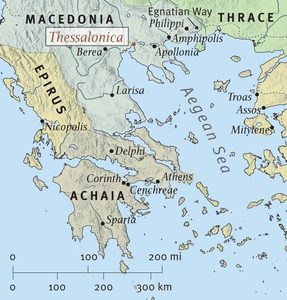
The city of Thessalonica still exists today. Although it is now known as Thessaloniki, having a population near 300,000, it is a port city in the northeast of Greece on the Thermaic Gulf of the Aegean Sea —notice the Egnatian Way up in the top right, since I will come back to that in a moment. According to commentators,[6] both of Paul’s letters to the church at Thessalonica give powerful testimony to the struggles of this early church and the suffering of its members. The letters demonstrate its members faced separation from their leaders, alienation from former friends, and recurring threats of persecution and even death. “Why?” you might ask.
To understand why we need to appreciate the city’s ongoing dependence upon Roman patronage and the role that dependence likely played in the relations between Paul’s church and the larger Thessalonian society.

I grew up in the industrial manufacturing city of Hamilton, in Canada. Hamilton is about an hours drive from Toronto, which is recognised as an international centre of business, finance, arts, and culture, and is recognised as one of the most multicultural and cosmopolitan cities in the world.
With sixty percent of Canada’s steel produced in Hamilton, the city is known as the Steel Capital of Canada. When that manufacturing industry came under pressure, the city needed to ensure alternative sources of income. One way they did this was to become a bedroom community for Toronto. To this end, they upgraded old roads and opened up the train line to make travel easier and quicker between Hamilton and Toronto. They also upgraded a number of shopping centres, instigated new housing developments, and redeveloped the waterfront for families and tourists. These initiatives attracted investors from Toronto. All of this is what we call patronage.
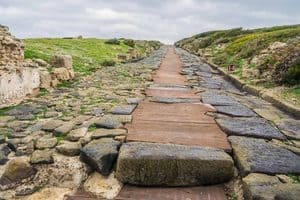
In the ancient context, the Via Egnatia —Rome’s gateway to its eastern colonies— was constructed in 130 bc, and Thessalonica benefited from the traffic, becoming a key trading and shipping centre. Perhaps as a result, the inhabitants of Thessalonica actively sought the good will of the Romans. The city’s loyalty to the emperor Augustus Octavian resulted in it being granted the status of a free city with an independent government. By the time Paul visited, a statue of Augustus had already been erected as one of its several honours to the Romans.
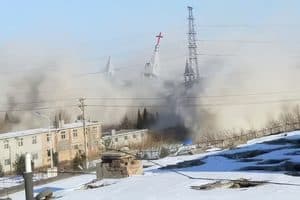
It is likely that adoration of Christ instigated a conflict with Thessalonian inhabitants and community leaders favourably disposed to the Roman government. Paul’s teachings emphasising salvation through Jesus and the beginning of a new age would be seen to weaken support for the Romans, who had brought obvious benefits to the city. Also, criticism of the Christian community would have been seriously hostile because most Gentiles were angered and opposed to Christianity’s exclusive claims on its adherents’ lives. Their ire was raised because those converting to Christianity were encouraged to discontinue any and all allegiance to their former religious communities. Finally, Roman culture allowed freedom of religion as long as its citizens also followed the cult of the emperor, which Christian leaders discouraged.
In all of these ways, the Christian sense of exclusive adoration of Christ ‘rankled many feathers’, resulting in much persecution and violence against them in Thessalonica. Which makes our scripture focus even more surprising and worth a close look.
The apostle Paul founded the church at Thessalonica after facing difficulties himself at Philippi (1 Th 2:1–2). His experience at Thessalonica was not that much different, which makes it surprising that Paul wrote “[I] always thank God for all of you, making mention of you constantly in [my] prayers” (1 Th 1:2). Paul thanked God for them in his prayers for three reasons I want us to pay attention to, especially noting the Thessalonian Christians were in the midst of suffering.
The Work of Faith
The apostle wrote,
We remember your work of faith and labour of love and steadfastness of hope in our Lord Jesus Christ in the presence of our God and Father (1 Thessalonians 1:3)
The first thing Paul thanked God for, on their behalf, was their “work of faith”.
The order here is important! This is not a work that produced faith but a faith that produced work. Their work was instigated by their faith.
From The Letter to the Romans, we understand “by the works of the law no person will be declared righteous before [God]” (Ro 3:20). In his Letter to the Galatians, Paul put it this way: “we may be justified by faith in Christ […] because by the works of the law no human being will be justified.” (Ga 2:16). These scriptures tell us there is nothing you or I can do to be reconciled to God our Creator; yet, once we become reconciled, we discover there is work for us to do for God and for others. Our faith in Jesus produces work for us to do for Jesus.
This work produced by faith is a good thing. Why? Because of the second thing Paul thanked God for, on behalf of the Thessalonian Christians.
The Labour of Love
Paul made a distinction between work and labour. “Work” refers to the task itself while “labour” refers to the energy, and possibly even pain, endured in the performing of the task. Labour takes us to the point of exhaustion because it is more intense than work.
To labour is to lose one’s self for the cause. Only love can produce this kind of labour.
The Greek word for love used here is “agape”, the God-kind of love. It is labour that is inspired by the love of God for us and his creation.
News of the Thessalonians’ labour of love, mixed with strong faith and hope, had spread throughout the region and was talked about by all (1 Th 1:7- 8). No one talks about a job done; they only talk about a job done well —that is done with an unusual enthusiasm and extraordinary creativity. The Thessalonians’ labour was noteworthy especially because it revealed the third thing Paul thanked God for, on their behalf.
The Steadfastness of Hope
The persecution faced by the Thessalonian Christians was severe but nothing could kill their endurance based on their hope of glory. Their hope was steadfast.

To illustrate this, I want to show you my Oxfam Trailwalker buff. The Oxfam Trailwalker was a 100 km team event along the Great Northern Walk from Brooklyn, NSW, to Mosman. I was rewarded with this headgear for participating in five events —I am sad to admit I only completed four.
It is true this 100 km walking adventure event required an inordinate amount of endurance. What I am certain you cannot imagine is that I complained the whole way! Even worse, the event revealed I am impatient, pushing myself and my teammates to go faster than we were capable of or enjoyed, which is why I have only completed four events. None of my teammates talk about my endurance because they have been too annoyed by my impatience ☺
Not so the Thessalonians! They endured their suffering with patience and their endurance was steadfast, according to Paul the apostle. Their patience and endurance was so praiseworthy that he thanked God for them.
The work of faith, the labour of love, and the steadfastness of hope. Paul thanked God for them not only because the Thessalonians exhibited these graces, but because they were known for them. They had developed a reputation for them because in the midst of their suffering…
The Word Of The Lord Rang Out From Them
The apostle wrote that
from you the word of the Lord has sounded forth, not only in Macedonia and Achaia, but in every place your faith toward God has gone out, so that we have no need to say anything. (1 Thessalonians 1:8)
It seems that as the Thessalonians committed themselves to their work of faith, the good news about their faith in God spread far and wide. It “sounded forth”, which brings to mind the blowing of a horn that calls the warriors to gather for battle —like when Boromir sounded the Horn of Gondor to summon help when he, Merry and Pippin were being attached by Uruk-hai orcs. To hear such a thing immediately grabs your attention, for it is hard to ignore —I was on the edge of my seat during that scene in the movie “The Fellowship of the Ring”. Similarly, the saving faith of the Thessalonians was the topic of many conversations in their region, since it demanded the attention of their neighbours.
In other words, as the Word of God came to the Thessalonians, through Paul, with power (1 Th 1:5), it went out from them (1 Th 1:8) in power as their faith produced work for them. This tells us that in the midst of their suffering, the Word of the Lord sounded forth from them as…
They Served The Living And True God
For [those who heard of your faith] themselves report […] how you turned to God from idols to serve the living and true God (1 Thessalonians 1:9)
The second grace they were noted for is that whoever heard about the Thessalonians’ faith in God were so inspired by the story they themselves told others how the Thessalonians “turned to God from idols to serve the living and true God”.
Inspired? Were they though?
Paul could be describing positive reports about the Thessalonians’ faith or he could be describing negative reports from their neighbours.
Either way, the axiom is true: even bad publicity is still publicity. That the Thessalonians turned from idols to serve Christ Jesus was a story heard not only far and wide but talked about even further afield.
That the Thessalonians turned from idols to worship Christ denotes repentance. They converted from one religion to place their faith in Jesus and began to live a Christian lifestyle. They had been slaves to idols and had then, in their own words, willingly become servants to the Most High God. Their labour was motivated by love and was noticed by their neighbours such that they were talked about by their neighbours. Gossip with a good result, yes, but still not a good reason to gossip ☺
Finally, looking closer at our scripture focus we learn that in the midst of their suffering, the Word of the Lord rang out from them as they served the Living And True God and…
They Waited For His Son From Heaven
The apostle wrote that the Thessalonians
await his Son from heaven, whom he raised from the dead, Jesus, the one who delivers us from the coming wrath. (1 Thessalonians 1:10)
Placing their faith in Jesus, the Thessalonians felt compelled to work for him and his cause. This was a labour motivated by love, a work they committed themselves to labour at with endurance inspired by hope. This leads us to ask for what did the Thessalonians hope in the midst of their suffering?
The answer in verse 10 are:
- The resurrection of Jesus (“whom he raised from the dead”)
- The ascension of Jesus (“await his Son from heaven”)
- The second coming of Jesus (“from the coming wrath”)
The resurrection and ascension were historical events attested to by actual people who were present to witness those events. Based on this evidence, the Thessalonians felt they had every reason to believe the promise that Jesus would return. They wanted to be on the right side of history, to be counted among the friends of Jesus who exude his character by conforming to his likeness. They wanted to escape the coming judgment.
When asked why their faith produced work and their labour was motivated by love, as they endured with hope in the midst of their suffering, the Thessalonians could say they waited with confidence for the return of Jesus. They knew themselves to be more than servants but friends who were seeking reunion with Christ Jesus our Lord.
Now What?
“That’s good for them”, you might be thinking, “but not relevant to our day and age”. Do you really think that the experience of Christians today is any different from the suffering and persecution experienced by the Thessalonians?
Christians Are Now Being Punished For What Others Think

The Australian news service Eternity News reported once about a Christian school teacher in the UK, Kristie Higgs, who was dismissed from her job because of Facebook posts critical of transgenderism and sex education. At the time of publication, the teacher had lost her case at a UK employment tribunal.[7]
Listen to this very closely: the tribunal decided that Mrs. Higgs was not sacked for her Christian beliefs. They also accepted that her beliefs were not transphobic or homophobic. So why then did the tribunal agree that Higgs had committed such ‘gross misconduct’ that she deserved to lose her job?
The story is that two years prior, Mrs. Higgs shared a petition on her private Facebook page. She used her maiden name and did not mention her employer. She was concerned about her nine-year-old son being taught that gender is just a social construct and that one can change their gender if they wish. This public school teacher objected to the recently introduced and now mandatory Religious and Sex Education curriculum which the UK government had determined was to be taught to children as young as four. She argued, correctly, that it was indoctrination.
But an anonymous complainant went to the headteacher of her school and described her posts as “homophobic and prejudiced to the LGBT community”. Mrs. Higgs was subsequently investigated, suspended and fired. The panel which investigated her, said her views were “pro-Nazi” and she was told to “keep your religion out of it” when she tried to defend herself.
According to the tribunal, Mrs. Higgs’ dismissal “was the result of a genuine belief on the part of the school that she had committed gross misconduct”. The tribunal correctly understood Higgs was not dismissed for her beliefs but rather because of the beliefs of the school.
Whether you agree with her opinions or not, this is a case of a person suffering due to misunderstanding and being challenged for holding Christian beliefs! And it happens in Australia as much as anywhere else.
Let us, like the Thessalonian Christians, commit ourselves to the work produced by our faith in Jesus and labour inspired by love, as we endure with hope even in the midst of any suffering we might experience.
A Strategic Withdrawal
This leads us to our final question: how and when might we too exude the character of a friend of Jesus in the midst of our suffering?

One answer is offered by Rod Dreher, an American journalist concerned about the collapse of Western culture which he argues can be seen in the degrading of sexual ethics. In his 2017 book The Benedict Option, he describes our culture as filled with rampant materialism and exploitive consumerism, so distracted by technology it is not even aware a problem exists. It is hard to argue with Mr. Dreher.
Dreher proposes Christians take a “strategic withdrawal” from the world. He argues that those who truly want to follow Jesus must take this commitment seriously, and to take it seriously in all aspects of life: in politics, at church, in the home, in school, at work, and in the bedroom. This requires an intentional decision to think, live, and love differently than “the behaviours and customs of this world” (Rom 12:2, NLT).[8]
Dreher recommends:
- families set regular times for prayer and Bible reading;
- politics be about serving the local community;
- churches focus on worship, not entertainment;
- education encourage and equip the learning of virtue;
- work approached as a vocation, where one stewards the talents and blessings of God for His glory;
- sex be celebrated only in the context of marriage between a man and woman as a reflection of the intimacy and life-giving nature of God Himself; and,
- technology utilised as a servant to these purposes, not a master of the world’s purposes.
Dreher is not proposing we isolate ourselves from the world. Rather we are to be in the world but not of the world.[9] As friends of Jesus, we are to live and participate in the world but do so out of very different commitments than our neighbours. This is what a “strategic withdrawal” looks like. To actively resist conforming to this age, with its violence and chaos, its willing sinfulness.
Conclusion
For the friends of Jesus, our work is produced by our faith, our labour is inspired by love, and we endure everything out of a hope that all will be renewed and made right. We can exude the character of Jesus even in the midst of suffering by knowing ourselves to be more than servants but friends who are seeking a reunion with Christ Jesus our Lord.
Endnotes
[1]This sermon is adapted from an outline provided by John D. Cameron, “Christian Characteristics”, ed. Maze Jackson, Golden Nuggets 28 (1992).
[2]Unless otherwise noted, all scripture quotations are taken from The Lexham English Bible (Bellingham, WA, USA: Lexham Press, 2012).
[3]Our Daily Bread writers, quoted in Paul Lee Tan, “Just Stay By His Side”, Encyclopedia of 7700 Illustrations: Signs of the Times (Garland, TX, USA: Bible Communications, Inc., 1996), pg 985.
[4]G. Curtis Jones, “Challenging Example”, 1000 Illustrations for Preaching and Teaching (Nashville, TN: Broadman & Holman Publishers, 1986), pg 191.
[5]Reprinted by permission of Westminster John Knox Press from Feasting on the Word® Worship Companion, ©2015.
[6]Abraham Smith, “The First Letter to the Thessalonians”, New Interpreter’s Bible, ed. Leander E. Keck, vol. 11 (Nashville, TN, USA: Abingdon Press, 1994–2004), pgs 673-8.
[7]David Robertson, “Christians Are Now Being Punished For What Others Think”, Eternity News, 12-Oct-2020, https://bit.ly/2SWg7kb (accessed 16-Oct-2020).
[8]Holy Bible: New Living Translation (Carol Stream, IL, USA: Tyndale House Publishers, 2015).
[9]See John 17:11; 15:19; Galatians 5:19–21.

Leave a Reply