
In the explanation of the Parable of the Soil, the sower is missing. The onus is on the hearer, but what about the sower? What could he or she do differently to more effectively sow the seed of the good word and make disciples?
The scripture focus of this sermon is Matthew 13:1–9, 18–23. You would do well to read the passage in advance of reading the transcript or watching the video of this sermon.
This sermon was delivered at Campbelltown Uniting Church on Sunday, 12 July 2026.
Transcript
Learning to Swim

My family and I saw together the 2023 movie blockbuster, “Indiana Jones & the Dial of Destiny”. In my humble opinion, this final chapter of Indiana Jones’ story is much better than the previous chapter, “Indiana Jones & the Kingdom of the Crystal Skull”, but it did a great disservice to the character of Indiana Jones, turning him into an irrelevant and grumpy old man instead of the adventurous hero we all appreciated in the early movies of this franchise..

Besides ruining the main character, there is a scene in the movie which is quite unbelievable —again, in my humble opinion. In the scene in question, a ship captain, played by Antonio Banderas, tells the young Teddy character that swimming is easy. According to the captain, all you do is, “reach, then pull”.

Later in the movie, we see Teddy reciting that mantra as he swims, after falling into an underground waterway.
While we were all happy the character did not drown in that scene, swimming doesn’t actually work that way and no one learns how to swim that quickly!
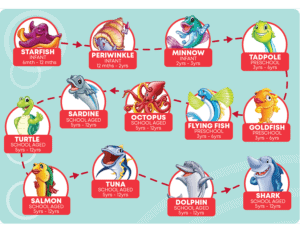
In actual fact, when learning how to swim, you progress through stages, adding skill upon skill until you reach swimming competency. You cannot become a Thorpedo until you have first been a salmon and then a shark, and everyone starts out no higher than an octopus!
What & Why?
Similarly, faith is NOT an either/or situation, as if you either have faith or you do not. We all start with a lack, then are helped to recognise we have a lack. Only then will we be ready to learn of and accept the solution to the problem, that placing our faith in Jesus and living a Christian lifestyle prepares us for the light and life and love he offers.
Explanation
Our scripture focus today has us reading and reflecting on a familiar parable. It is known colloquially as The Parable of the Soil (or Sower). What makes this parable exceptional is that an explanation of the parable is provided.
Faith Requires Seeking
The parable begins with a description of a scene:
On that day Jesus went out of the house and was sitting by the sea. And large crowds gathered close around him, so that he got into a boat to sit down, and all the crowd was standing on the shore. (Matthew 13:1–2)[1]
As we read this, we cannot help but be amazed at the description of “large crowds”. Our attention and imagination is drawn to the sheer, but unprovided, number. We do not ask why there was such a large crowd, whatever that means, but maybe we should. Why did those people gather close around Jesus?
They gathered because they wanted to see and hear Jesus. While they did not understand him perfectly (Mt 16:13-14), and possibly not correctly at all, they recognised in him enough to know he knew something they did not. ‘Deep down in their bones’ they sensed he had something they needed to know and receive (Jn 6:67-69).
On this the prophet wrote the words of God he received,
When you search for me, then you will find me, if you seek me with all your heart. (Jeremiah 29:13)
While we all agree we would not know God exists without the Spirit revealing him to us, it is also the case that we will never come to faith without seeking God.[2]
“Did not our hearts burn with us?” the disciples on the road to Emmaus asked (Lk 24:32). The words Jesus shared with them, and their experience with him, opened their eyes to see and their ears to hear. They then wanted to see more and hear more, so that their longing would be satisfied. They, therefore, invited Jesus in for dinner even though they knew not who he was at all. They must have truly been interested to invite into their home a stranger.
Similarly, the crowd gathered to hear Jesus that day because faith requires seeking and seeking must be sparked. Both conditions were met for the crowd. Their attention was caught so they sought out Jesus to hear more from him.
The Parable of the Sower
When that large crowd gathered, Jesus taught them many things, including the now well-known parable:
Behold, the sower went out to sow, and while he was sowing, some seed fell… (Matthew 13:3b–4a)
I am quick to admit, I am neither a farmer nor a gardener; yet, even I am intrigued by this story of a sower planting seed in soil.
What makes this parable especially interesting is that an explanation is provided just a few verses later than this introduction; however, the explanation presents a different perspective on the parable than what is more likely in the telling. So, we have one parable and two perspectives on that parable that are both from Jesus.
That fact alone should convince you to pay especially close attention!
Beginning at verse 3, the focus of the parable is on the sower, for Jesus stated, “Behold, the sower…” From this opening then, we learn:
- The victory of the kingdom of God is certain. It is the sower doing the work and his work will result in a harvest beyond expectation —a hundred, maybe sixty, at the very least thirty times what was sown. The friends of Jesus pray for the Kingdom to come (Mt 6:10) —AND IT WILL!— for the seed is sown and the harvest is God’s doing.
- The Word encounters many difficulties between its sowing and the eventual harvest. The friends of Jesus should not be surprised by this, nor feel threatened by it.
- The responses and actions, or not, of those in whom the seed is sown do not themselves hinder the eventual harvest. Only the presence of “fruit” reveals the quality of the soil —which is to say, if fruit is produced, then the seed has been planted in good soil. Spiritual ‘fruit’ reveals whether one is a friend of Jesus or not. As a consequence, Christians should not assume they are “good soil” for “you’ll recognise them by their fruit”, Jesus warned elsewhere (Mt 7:20).
Learning these lessons, this parable leads the friends of Jesus to praise and thanksgiving, for the Word goes out and will return a harvest. The Kingdom will come! It has been promised. Thank God, therefore, for the sower!
The Parable of the Soils
Our scripture focus then continues at verses 18-23, where an interpretation of the parable is provided by Jesus to the disciples (Mt 13:10), but not to the large crowd to whom the parable was originally given. We can take this to mean the parable and this interpretation were likely given at different times and in different places, maybe even at many times and in many places.
You, therefore, listen to the parable of the sower: When anyone hears the word about the kingdom… (Matthew 13:18–19a)
While Jesus identified the original parable was about a sower, in this interpretation he moved the focus to the soil. The soil is a metaphor for the one who hears the word sown by the sower:
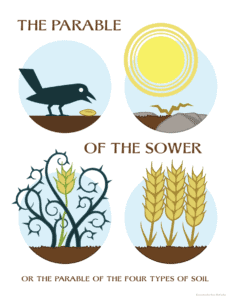
- When the seed falls on a path, worn by use, it is devoured easily by predators, so will not produce fruit.
- When the seed falls on rocky ground, with some but little soil, it grows quickly, as if joyfully, but dies just as quickly because of the lack of depth to the soil in which it is planted. It will wither under the heat of the day or other distress, having no roots, so will not produce fruit.
- When the seed falls among thorns, it grows but is choked by worries and greed, so will not produce fruit.
- When the seed falls on good soil, it produces fruit not only plentifully but beyond expectation —a hundred, maybe sixty, but at least thirty times what was sown. It produces fruit beyond the one who hears, like when a plant’s own seed is scattered to produce other plants.[3]
Where in verses 1-9, the emphasis of the parable was on the harvest resulting from the efforts of the sower, in verses 18-23 the parable is much more directly meant to cause us to reflect on the question, what kind of soil are we?
Application
Will You Produce Fruit?

Bread-fruit tree of Australia produces fruit on its branches when it is young; on its trunk when it is middle-aged; and on its roots when it is old.[4]
Jesus’ telling of this parable is not meant to describe stages of faith, as if a person moves from being as hard as a path, to being rocky, then thorny, and finally good soil. In both of Jesus’ perspectives on this parable provided in our scripture focus, the seed fell on the ground of a person’s heart or mind, and that soil was either hard, rocky, or thorny, or it was good soil that produced fruit.
The point I believe Jesus wanted us to understand is there is soil that produces fruit and there is soil that does not. Whether the plant itself grows a little or a lot is not the point, neither is the amount of fruit really the concern for Jesus in these tellings of the parable. The concern is that we understand the plant is only as good as the fruit it produces.
The question posed by this parable then is simple: When you hear the word about God from Jesus, will it produce fruit in your life? Many years ago theologian Henry Sloan Coffin said,
Every Christian is called by the Master to follow Him, and that following may be in a carpenter’s shop as well as in preaching and teaching. All Christians are ordained to bear fruit.[5]
You are hearing me share the word about God from Jesus, so do my reflections stir anything within you? Are you even now compelled by the Holy Spirit to make a change in your thoughts, words, and deeds? Any change prompted by hearing the Word and the stirring of the Holy Spirit is going to produce fruit. Do not recoil from that stirring but surrender to it. Follow its lead.
The word sown will yield a harvest. Whether you are just now placing your faith in Jesus or are “reaching the unity of the faith and the knowledge of the Son of God” (Eph 4:13), will you be counted among that harvest? Will you produce fruit?
Will You Help Produce Fruit?
Our scripture focus provided a parable of Jesus and a second perspective on that parable from Jesus. One parable, two perspectives. Now, I do not want to suggest I am smarter than Jesus, but allow me to apply my wisdom and vast ‘edumacation’ to provide a third perspective on Jesus’ parable. For that perspective, allow me to introduce the VeggieTales singers:

The VeggieTales animated series was fun and gives me the chance to ask whether you are you a tomato, a cucumber, or an asparagus in Jesus’ harvest? (any VeggieTales fans in the house?)
I am only kidding, of course. But there certainly is more to glean from this parable. Jesus certainly did not intend to exhaust the vast riches of his wisdom and teaching in a single sermon or teachable moment, rather he invites us to mine this parable deeply. Let us consider another perspective to add to the two perspectives of Jesus this gospel provides.
As I mentioned before, with this parable Jesus was not describing stages to faith; however, the parable does not preclude the option that the bad soil might become good soil. Indeed, the prophet encouraged this when he wrote,
Sow for yourselves righteousness; reap loyal love. Break up for yourself fallow ground; it is time to seek Yahweh so he will come and rain righteousness upon you. (Hosea 10:12)
Within the Bible, the images of sowing and soil come up time and time again. In fact, these images will come up again in my sermon next week. Each time these images are used, however, they may be employed differently.
In this prophet’s use of the images, he recognised our part in turning the soil of our life from bad to good. Again, I am no gardener, but I am pretty sure soil cannot apply any effort toward its own progress. Left on its own, soil will only denegerate from good to bad. This leaves us with no other thought than that turning soil from bad to good requires outside intervention.
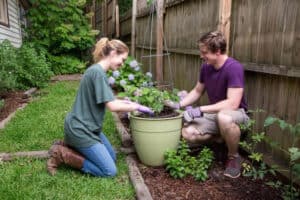
In the context of Jesus’ parable, he is the sower of seeds. The seeds fall on the ground as it is. In turning bad soil to good then, it cannot progress without help. That is where gardeners come in after the sower.
We might then say, by implication, the friends of Jesus are invited to help turn the bad soil of a person’s heart into good soil (i.e., we are called to make disciples).
What can we do to intentionally prepare the people around us, with whom we have influence, to help change bad soil to good soil, so that the good Word will produce fruit in them when the seed is sown?
Please note I am not talking about the sowing of the seed, but preparing the soil. How do we prepare people to respond favourably to the good news about Jesus when they hear it?
In terms of people’s hearts, it might be a good place to start by asking why and how do they become bad soil, whether hard or rocky or surrounded by thorns? They become bad soil when the cares of this world become overwhelming and they only know to how to act like ‘children’ —naïve, immature, self-absorbed, and selfishly manipulating others. They need to be shown a better way, the Way of Love, but I dare say they also need to feel their lack more painfully.
Glen Scrivener is an Australian evangelist and author who has a video on Youtube titled, “What Christians believe…in 90 Seconds!”[6]
In his presentation, Scrivener describes,
In the beginning, there was light and life and love. Out of this has come a world destined to share this light and life and love, but the world is not like that, is it? When we turn away from the light, there is only darkness; when we turn away from the life, there is only death; when we turn away from the love, there is only disconnection. Do you feel that loss? What have you thought, said, or done to fill those gaps? Has that worked for you? (paraphrase)
Agreeing with Scrivener’s presentation of the Gospel, it seems to me that when we can get people to honestly assess the human condition, they cannot help but recognise something is broken within them and around us, something is lost, there is no hope for them or anybody.
Once they recognise this loss, they then need to be encouraged to long for something more and better; to move from darkness to light, death to life, disconnection to love.
That sense of loss may seem painful to admit, but until one recognises there is a problem, he will not seek a solution. The psychologist character, Dr. Sharon Fieldstone, that appears in the Ted Lasso television series, very correctly identified for Coach Ted, “The truth will set you free, but at first it will [make you uncomfortable].”
All truthful and painful joking aside, the prophet wrote this relevant encouragement from our Creator,
When you search for me, then you will find me, if you seek me with all your heart. (Jeremiah 29:13)
That is a description of good soil.
Not recognising the human condition is like hard soil; recognising something is broken is like rocky soil; seeking answers in the wrong places is like thorny soil; desperately wanting light, life, and love is good soil.
Thus, helping people feel their lack more palpably will prepare their hearts for the Word to be sown and fruit to be produced. Will you help produce fruit? Will we together help to produce fruit in others?
Helping people to recognise their lack and their loss, and showing them a better way is much easier than you think. It will often involve telling stories. Let me give you an example:

I once attended a book launch. A friend of mine, Dr. Patricia Weerakoon, has written a book, with two other authors —one of whom is her pastor-son Kamal. Their book is titled, “The Gender Revolution: A biblical, biological, and compassionate response”.
You may have heard of Dr. Weerakoon. She is a renowned relationships and sexual health researcher. You more likely know her from her stint on the ABC television show Agony Auntswith media personality Clive Robertson and business guru Sally Wilson. It is from that show she earned the respect and affection of the nickname “Auntie Pat”.
At the book launch, the emcee described how everyone has “an Auntie Pat moment”. What he meant by this is when you first meet or hear Patricia teach that “sex and the wonder of human genitalia are gifts from God that should be celebrated”, you will likely be floored by her forthrightness and uncensored way of talking about a subject one does not normally bring up in polite company. However, her smile and bubbly personality will soon put you at ease and you will wonder at how she unabashedly praises our Creator for the gifts of love and sex.

Now, did you see what I did there? I shared with you a story about Dr. Patricia Weerakoon. Some of you have already started googling her to find out more about her research and advice. Some of you can’t wait to buy her book —I can proudly say I was the first person to buy the book at its launch. Some of you are ‘chomping at the bit’ to go out to morning tea to describe your own ‘Auntie Pat moment’. My wife and I can top all your stories as Patricia did our pre-marriage counselling.
The point is I shared a story of a person that brought to mind your own positive or negative experiences, and led you to wonder how you might have a better sex and love life. You are likely wondering how Auntie Pat might help you with your dating or marriage relationship. With my story, you were led to consider your own lack or loss and to yearn for something more and better.
When we share the stories of Jesus they are stories of hope! And there are seven stories of hope that are particularly good at helping people recognise how they are lacking and have lost light and life and love:
- The woman who wept (Luke 7:36-50)
- The parable of the Pharisee and the Tax Collector (Luke 18:9-17)
- The men let down through a hole in a roof (Luke 5:17-26)
- The parable of the lost son (Luke 15:11-32)
- Jesus being led to his crucifixion (Mark 15:16-39)
- Jesus’ resurrection and the Great Commission (Matthew 28:1–20)
- The parable of the Sower (Mark 4:1-20)
You and I and all of us should know these stories inside and out, so that we are prepared to share them in natural conversation.
If anyone you know expresses even the slightest hint of an awareness of their lack and loss, then whip out one of these stories —do not read them from the Bible, but tell them in your own words! In the gentle and respectful telling of these stories, the people around us will be led to yearn for the light and life and love Jesus makes available to us.
I want us all to be ready to share these stories of hope and know how to lead people in a simple Bible study beginning with these passages. By helping others engage these stories of hope, you are helping them to hear the good news about Jesus, and how he leads us all from darkness, death, and disconnection to light, life, and love.
Conclusion
A simple story of hope CAN soften up the ground of a person’s heart to spark seeking and faith. We can, each and together, turn bad soil into good soil, and so prepare those with whom we have influence to be ready for the Word to be sown, which will yield the fruit of a life saved and transformed.
This parable, and its multiple perspectives, invites you to consider the quality of the soil of your heart. Are you hearing the good news about Jesus and being stirred to faith? Are you being stirred to make a change in your thoughts, words, and deeds? Let that seed blossom in your life so that you are yourself counted amongst God’s great harvest.
Endnotes
[1]Unless otherwise noted, all scripture quotations are taken from The Lexham English Bible (Bellingham, WA, USA: Lexham Press, 2012).
[2]Psalm 63:1; 78:34; Isaiah 26:9; Hebrews 11:6; cf., Psalm 14:1–3.
[3]The conclusion of this parable is likely as allusion to Gen 16:12. “If that is true, then the only place where Galilean farmers would have heard of reaping a one hundredfold harvest was in the “unrealistic” world of the Bible. On this basis, Jesus’ story begins in the ordinary world and concludes in the biblical world of hope and promise.” —M. Eugene Boring, “The Gospel of Matthew”, New Interpreter’s Bible, ed. Leander E. Keck, vol. 8 (Nashville: Abingdon Press, 1994–2004), 303.
[4]Paul Lee Tan, “6804 Strange Fruit Tree”, Encyclopedia of 7700 Illustrations: Signs of the Times (Garland, TX: Bible Communications, Inc., 1996), pg 1501.
[5]G. Curtis Jones, “Bear Fruit”, 1000 Illustrations for Preaching and Teaching (Nashville, TN, USA: Broadman & Holman Publishers, 1986), pg 236.
[6]Premier Unbelievable, 6-Dec-2017, https://replug.link/54d67860 (accessed 14-Jul-2023).

Leave a Reply